CON COR 280225 Jb Hunt Container 48-FT
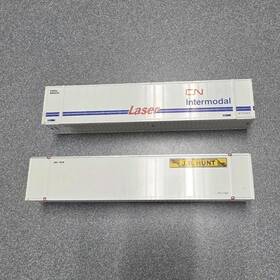
( Brand: Con Cor ), ( Manufacturer Part Number: 280225 ), ( Assembly Status: Ready To Go/pre-built ), ( Type: Intermodal Container ), ( Color: White, Yellow ), ( Age Level: 17 Years Up ), ( Gauge: Ho )
Review CON COR Cn Jb Hunt 48 Ft Container
The **Cor 280225 JB Hunt 48-Foot Container** is a high-performance, heavy-duty intermodal shipping container designed for the demanding needs of global logistics and freight transportation. Built to the highest industry standards, this container exemplifies durability, efficiency, and versatility, making it an ideal choice for shippers, carriers, and logistics providers who require reliable, long-lasting cargo protection. Constructed from **corrugated steel** with a **20-gauge wall thickness**, this container features a robust **corrugated design** that enhances structural integrity while reducing weight, ensuring optimal load capacity and stability during transit. The **48-foot length** provides substantial additional volume compared to standard 20-foot or 40-foot containers, allowing for greater cargo capacity up to **2,320 cubic feet** without compromising on strength or maneuverability. Its **corrugated sidewalls** not only resist dents and impacts but also offer superior resistance to corrosion, extending the container s lifespan even in harsh environmental conditions.
This container is equipped with **standard 8.5-inch corner castings** and **100-ton rated twist locks**, ensuring secure fastening to chassis, flatbeds, or other containers during shipping. The **double-door design** with **aluminum or steel frames** provides easy access for loading and unloading, while the **reinforced roof** and **floor** offer additional protection against moisture, UV degradation, and mechanical stress. The **corrugated pattern** also contributes to natural ventilation, helping to regulate internal temperature and reduce condensation, which is particularly beneficial for sensitive or perishable goods. For added security, the container features **padlock-compatible hasps** and **reinforced locking mechanisms**, deterring unauthorized access and tampering. Its **lightweight yet sturdy construction** optimizes fuel efficiency for carriers, reducing operational costs while maintaining high performance.
The **JB Hunt branding** signifies that this container is part of a trusted fleet known for reliability and innovation in the transportation industry. Whether used for **full-container loads (FCL), less-than-container loads (LCL), or specialized cargo**, this 48-foot container delivers unmatched flexibility and efficiency. Its **modular design** allows for easy customization, including the addition of **ventilation panels, temperature-controlled linings, or specialized coatings** for specific cargo requirements. Ideal for industries such as **automotive, electronics, consumer goods, and industrial manufacturing**, the Cor 280225 container ensures that shipments arrive intact, on time, and ready for distribution. With its **low-maintenance construction** and **long-term durability**, this container represents a smart investment for businesses seeking to enhance their supply chain resilience and operational efficiency.
### **Pros and Cons of Buying a 48-Foot Container (COR 280225, JB Hunt) for Purchase**
#### **Pros**
1. **Capacity and Space Efficiency**
- A 48-foot container offers significantly more cargo space than a standard 20-foot or 40-foot container, making it ideal for large shipments of bulk goods, oversized equipment, or high-volume inventory.
- The extended length allows for better utilization of shipping space, reducing the need for multiple containers and lowering logistics costs.
2. **Cost Savings on Freight**
- While the upfront purchase price may be higher than a standard container, the long-term cost savings from reduced shipping fees (especially for frequent or high-volume shipments) can be substantial.
- Companies with consistent cargo needs may benefit from lower per-unit shipping costs over time.
3. **Flexibility in Cargo Types**
- Suitable for transporting heavy, irregularly shaped, or oversized items that do not fit well in standard containers (e.g., machinery, construction materials, agricultural products).
- Can be used for specialized cargo like vehicles (if properly secured) or modular housing units.
4. **Resale or Rental Potential**
- High-demand containers in certain industries (e.g., construction, manufacturing, or logistics) can be resold or rented out when not in use, generating additional revenue.
- JB Hunt s branding and reputation may make the container more attractive to buyers or lessors.
5. **Durability and Longevity**
- Well-maintained 48-foot containers can last for decades, especially if used for storage rather than repeated shipping stress.
- COR (Corrugated) containers are designed for heavy-duty use, offering better structural integrity than standard dry van containers.
6. **Tax and Depreciation Benefits**
- Purchasing a container as a business asset may qualify for tax deductions, depreciation, or financing options, reducing the effective cost.
- Some countries offer incentives for investing in logistics infrastructure.
7. **Ownership Control**
- Owning the container eliminates reliance on third-party providers, allowing for better scheduling and cost management.
- No risk of container shortages or last-minute rental price hikes during peak demand.
---
#### **Cons**
1. **High Upfront Cost**
- The purchase price of a 48-foot container is significantly higher than standard containers (typically **$8,000 $15,000 **, depending on condition, age, and modifications).
- Requires a substantial capital investment, which may strain cash flow for small businesses.
2. **Limited Availability and Lead Times**
- High-demand containers (especially new or well-maintained ones) may have long wait times or require sourcing from multiple suppliers.
- Used containers may need inspections for structural integrity, rust, or damage before purchase.
3. **Storage and Maintenance Costs**
- Storing an unused container incurs additional fees (e.g., yard storage, insurance, or security).
- Regular maintenance (e.g., rust treatment, door seals, floor checks) is required to prevent deterioration, adding long-term costs.
4. **Logistics and Handling Challenges**
- 48-foot containers are longer and heavier, requiring specialized equipment (e.g., forklifts, cranes) for loading/unloading.
- May not fit in standard shipping lanes or terminals, limiting flexibility in transit routes.
- Some ports or rail systems have restrictions on oversized containers.
5. **Depreciation Risk**
- Like any asset, containers depreciate over time. If not used frequently, the resale value may drop significantly.
- Market fluctuations (e.g., surplus supply of used containers) can affect recovery costs.
6. **Financing and Insurance Complexities**
- Securing a loan for a container purchase may require collateral or higher interest rates due to the asset s specialized nature.
- Insurance premiums for high-value or oversized containers can be costly, especially if transporting hazardous or valuable goods.
7. **Potential for Lower Utilization**
- If cargo volume fluctuates, a 48-foot container may sit idle for extended periods, reducing ROI.
- Smaller shipments may not justify the container s size, leading to inefficient space use.
8. **Regulatory and Compliance Issues**
- Some countries have restrictions on container sizes for import/export, requiring additional permits or modifications.
- Non-compliance with weight, stacking, or safety standards (e.g., IMO regulations) can result in fines or delays.
---
### **Ending Conclusion**
Buying a **48-foot COR container (e.g., from JB Hunt)** is a strategic investment for businesses with **high-volume, long-term shipping needs** or those transporting **oversized/bulk cargo**. The upfront cost is justified by **cost savings on freight, flexibility, and ownership control**, particularly for industries like construction, manufacturing, or logistics. However, it is **not ideal for occasional or small-scale shippers**, as the **high purchase price, maintenance, and storage costs** may outweigh benefits.
The decision hinges on:- **Cargo volume and frequency** (justifies the investment).
- **Budget and financing options** (can the business afford the upfront cost?).
- **Storage and maintenance capabilities** (can the container be used efficiently?).
- **Market demand** (will the container remain valuable or depreciate quickly?).
---
### **Recommendation**
**Purchase the 48-foot container if:**Your business regularly ships **large, heavy, or irregular cargo** that cannot fit in standard containers.
You have **consistent demand** that justifies the cost (e.g., construction projects, manufacturing supply chains).
You can **secure financing** or have the capital to offset the high upfront cost.
You have **storage and maintenance infrastructure** to keep the container in good condition.
Resale or rental opportunities exist in your industry to recover costs when not in use.
**Avoid purchasing if:**Your cargo needs are **intermittent or small-scale**, making the container underutilized.
You lack **storage space** or **budget for maintenance**, risking depreciation.
Alternative solutions (e.g., leasing, using multiple standard containers) are **more cost-effective**.
The container s **resale market is weak** in your region, making recovery difficult.
**Alternative Considerations:**- **Lease or rent** the container short-term if demand is uncertain.
- **Buy used** (but inspect thoroughly for damage) to reduce costs.
- **Negotiate with JB Hunt** for bulk purchase discounts or financing options.
- **Explore container pooling** (sharing with other businesses) to reduce idle time.
**Final Verdict:**For businesses with **proven, high-volume needs**, a 48-foot container is a **smart long-term investment**. For others, **leasing or alternative shipping methods** may be more financially prudent. Always conduct a **detailed cost-benefit analysis** before committing.
Details:
Con Cor, cn, jb hunt 48 ' Container Con.
part #: 280225 price
- $320.00
specifications oscaletraini:
- brand: Con Cor
- mpn: 280225
- assembly status: Ready To Go/pre-built
- type: Intermodal Container
- color: White, Yellow
- age level: 17 Years Up
- gauge: Ho
shipping oscaletraini:
- transit: 4-10 Days
- service: USPS Ground Advantage
- carrier: USPS
- type: Calculated
- class: Standard
- cost: $5.39
seller oscaletraini:
- rating: 100.0%
- city: Mondovi, WisConsin
- # reviews: 782
offer oscaletraini:
- quantity: 1
- sold: 0
- started: April 11, 2026
- best offers: True
- options: Ship-to-home
- availability: In Stock
payments oscaletraini:
- wallet: Google-pay
- other
- credit card: Mastercard
returns oscaletraini:
- policy: No Returns
general oscaletraini:
- Railroads Trains > Parts Accessories > Other Parts Accs
- Condition: Used
Con Cor 280225 Is Similar To:
- 0001-094263 Con-cor Concor O Scale (18.7% similar) Manufacturer: Concord scale: o road NUMBER:3355PART number: car style: ho Santa Fe coach Pullman green Condition: brand new in the box never run shipping...(October 3rd, 2017)
- Con-cor 0004-001088 Ho Scale Con-cor 28ft Moving Van Truck Amtrak Commissary (32.5% similar) Please see pictures. Factory sealed...(September 1st, 2023)
- Con-cor 0004-132000 Ho 1 87 Scale Con-cor Freightliner Semi Truck Cab Yellow With Flatbed Trailer (30.4% similar) Have a great day and god bless. Will package carefully. In excellent Condition no cracks or breaks...(January 26th, 2024)
- Con-cor 04-006207 Con-cor Schneider National Trailer Single Smooth Side N Scale 1 160 04-006207 (21.9% similar) Original packaging not included. Some small surface level scratches present on the sides, these are visible in last few pictures. Ships via USPS ground advantage...(February 6th, 2024)
- Con-cor B-803 Con-cor Heljan Ho Steam Locomotive Roundhouse Northumberland Pa Kit b 803 (24.8% similar) You are buying on a Con-cor Helena ho steam locomotive roundhouse , pa kit #b 803. Please look at pictures carefully. Please no buying if you do not intend to pay. Item appears to be complete...(July 31st, 2024)
- Athearn 5159 Ho Lot Of 4 Walthers con Cor Truck Trailers Usps Santa Fe Rio Grande And Bud (24.4% similar) Sold as shown...(August 3rd, 2024)
- Con-cor 0001-000201 Con-cor Model Kit Big Boy Locomotive Union Pacific (23.4% similar) Kit 0001-000201. If error is made I will do everything can to Correct and make a 5 star sell...(August 8th, 2024)
- Con-cor 0069 Con-cor Ho Scale Two Story House (27.9% similar) Con-cor ho scale two story house...(August 22nd, 2024)
- Atlas 700108 Atlas roco Con-cor Sd-24 Locomotive Full Handrail Set 700108 New mint (20.6% similar) Combined shipping is available. Mint, complete and unopened package. O Ur stock is sold in as is Condition which it was acquired. Please view all photos and read the fully. USA .$ 6.00. Full handrail set. Their value is tied to their Condition: unopened/sealed. I will combine shipping for multiple ...(August 26th, 2024)
- Atlas 702310 Atlas roco Con-cor Gp-38-2 Locomotive Full Handrail Set 702310 New mint (21.9% similar) Mint, complete and unopened package. This set fits an atlas/Rico or Con-cor GP-38-2 locomotive shell from back in the day. I will combine shipping for multiple wins. Please view all photos and read the fully. Full handrail set. O Ur stock is sold in as is Condition which it was acquired. Except for ...(August 26th, 2024)
- Herpa 001072 Ho 49ft National Moving Van Tractor Trailer 1072 Con Cor (12.6% similar) Its perfect for hauling your model's around town or across the country. With a scale of 1:600 and gauge ho, this trailer is the perfect size for your trains. Made by a trusted brand, this trailer is built to last and will bring sense of realism your layout. Add it to your collection today and bring ...(August 30th, 2024)
